


Cover-Up Tattoos – The Complex Process Behind a Fresh Start
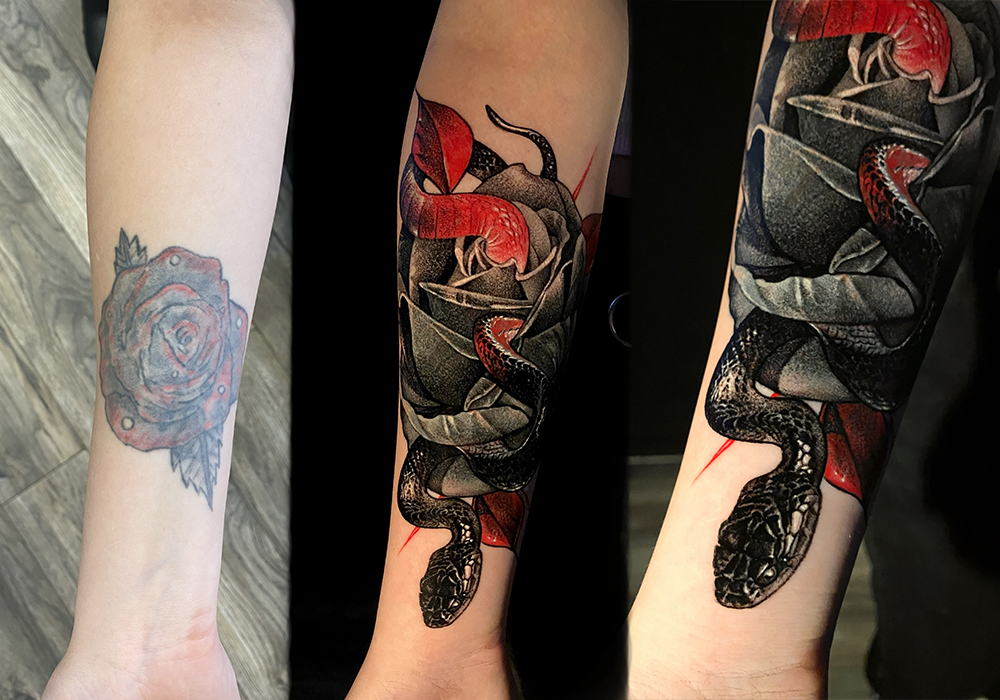
Cover-up tattoos represent one of the most difficult and demanding branches of tattoo art. It is not just about covering an old design, but about transforming an unwanted experience into one that truly represents the person wearing it. At TART TATTOO Studio Bucharest, we approach each cover-up as a personalized project, where experience, strategy, and communication are essential.
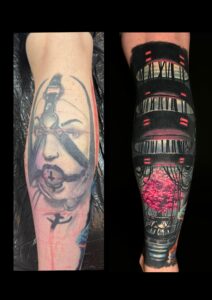
What is a cover-up tattoo, exactly?
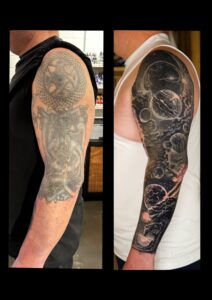
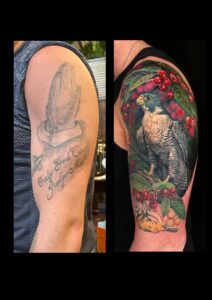
A cover-up involves creating a new tattoo over an existing one, so that the old one is no longer visible after healing. Unlike a tattoo done on intact skin, here the artist works on an “already marked territory,” with clear limitations imposed by:
- The existing pigment.
- The density and depth of the lines.
- The age of the tattoo.
- Skin quality.
These variables transform every cover-up into a complex exercise of artistic and technical adaptation.
Why are cover-up tattoos so difficult?
Old tattoos can look very different from case to case:
- Some are faded, uneven, with pigment “blown out” in the skin.
- Others are extremely dark, with thick, black lines, typical of old tribals or aggressive lettering.
A very dark tattoo severely limits the palette of solutions. That is why promises like “anything can be covered with anything” are unrealistic. An experienced cover-up artist will tell you exactly what is possible and what is not right from the consultation. Rarely can a tattoo measuring 5 square centimeters be covered with something of the exact same size.
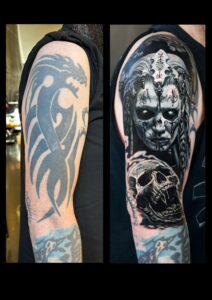
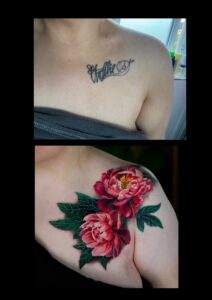
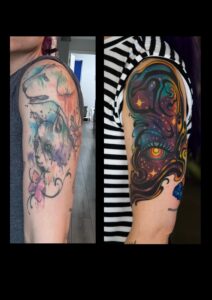
The Initial Consultation – The Foundation of a Successful Cover-Up
The consultation is, without exaggeration, the most important step in the entire process. During this meeting, we discuss:
- What bothers the client about the old tattoo.
- What aesthetic and style they desire and why.
- What solutions are realistically applicable.
- What compromises may be necessary (size, contrast, theme).
A good cover-up does not start with a beautiful sketch, but with correctly aligned expectations between the client and the artist.
The Importance of the Chosen Image and Style
Not every image works for a cover-up. Generally, the most effective are:
- Compositions with strong volumes and textures (stone/metal/wood sculptures).
- Images with areas of natural shadow and large shapes that allow the integration of old lines.
- Styles such as realism, black & grey, or neo-Japanese.
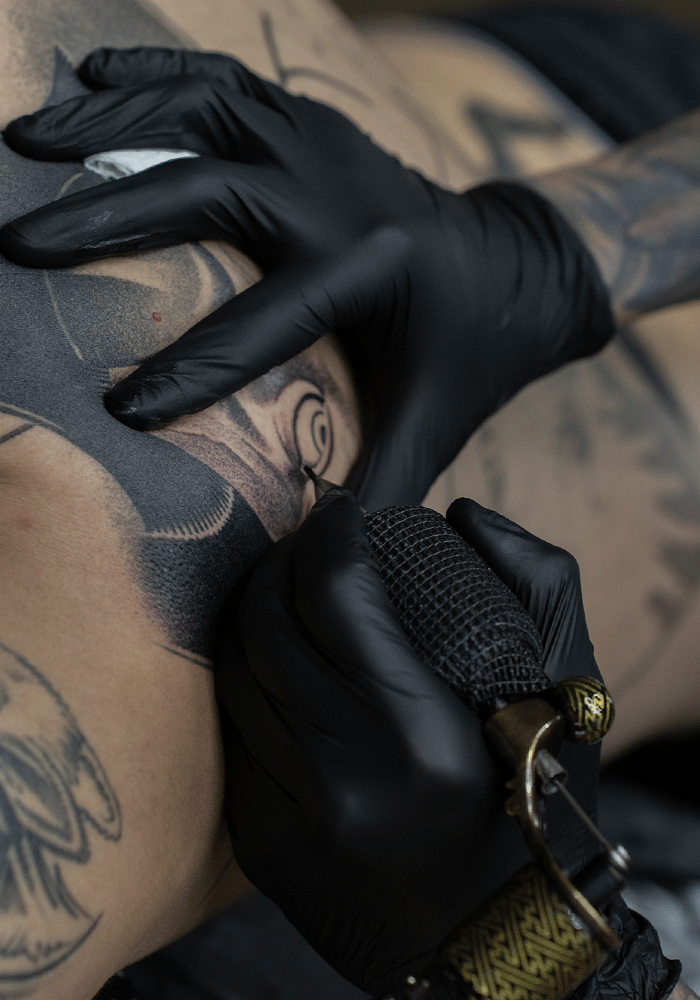
In many cases, the artist will draw directly on the skin (freehand), adapting the shapes in real-time to integrate the old tattoo. This process requires not only experience but also the client’s trust in the artist’s vision.
“There are many situations where I have to improvise directly on the skin, changing certain shapes and directions from the initial composition and model. That’s how I can achieve the best possible final result! Obviously, I inform my clients at every step of what I am going to do.”
— Lucian Tatar
Body Location and Size – Decisive Factors
The tattooed area can significantly increase the difficulty of a cover-up:
- Thin or mobile skin (ribs, neck, wrists) is harder to control.
- Small areas drastically limit options.
- Most of the time, an effective cover-up is larger than the initial tattoo.
Size is not an arbitrary aesthetic choice, but a technical necessity for the stability of the result over time.
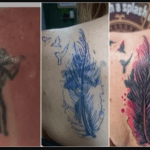
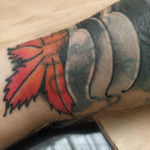
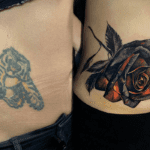
Duration, Costs, and Alternative Solutions (Laser)
A cover-up is rarely completed in a single session. Depending on complexity, the process may involve multiple sessions, longer healing times, and subsequent adjustments. The cost reflects the level of difficulty, the artist’s experience, and the time invested.
Laser – a strategic aid: For extremely dark tattoos (especially old tribals), we often recommend a few laser sessions before the cover-up. The goal is not complete removal, but to lighten the pigment to increase artistic options and obtain a cleaner, more durable result. It is a mature and responsible approach that significantly simplifies the process.
Cover-ups over Scars
In addition to old tattoos, at TART TATTOO Studio we also work with scars of various types, each with its own anatomical and healing peculiarities. We detailed this topic in a dedicated article on our blog: Learn more about tattooing over scars.
Conclusion – A Cover-Up Means Trust
A successful cover-up tattoo is based on the artist’s experience, honest communication, realistic technical solutions, and mutual trust. We, the collective of artists at TART TATTOO Studio Bucharest, specialize in complex cover-ups, difficult old tattoos, and their integration into a new visual story.
If you feel your tattoo no longer represents you, a consultation is the first step towards a correct and committed solution.