


Custom Composition: Why We Reject Flash Catalogs and Replicas
The tattoo industry has evolved significantly, yet the idea of a commercial shop where you walk in, pick a drawing off the wall, and leave with it printed on your skin a few hours later still persists. At TART Tattoo Collective, we reject this approach. We operate as a collective of visual artists, which means every piece we create is a completely original, custom composition.
Our clients choose us because they understand the value of a unique piece, tailored specifically to their body. In this article, we explain our creation process, how we handle visual references, and why anatomy dictates the final shape of any project.
1. The Myth of the Perfect Reference: Why We Don’t Copy Tattoos
One of the most frequent questions during the consultation phase is whether we can exactly reproduce a photograph found on the internet. Our answer is a definitive no. We do not cover or execute tattoos by other artists as exact replicas. Reference photographs serve as a creative starting point, not as a stencil to be copied.
There are two pragmatic reasons for this rule:
- Intellectual Property Integrity: We respect the work of other artists in the industry. A piece created by someone else was designed for another client, with a different physical structure and a different story.
- Technical Context: A design that looks great in a heavily edited social media photo might not be technically viable in reality, especially if it ignores the contrast rules necessary for proper healing over time.
2. Anatomy and Proportions: Tattooing as Three-Dimensional Art
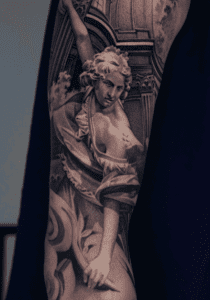
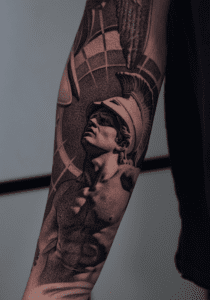
A drawing on a piece of paper is flat and static. Human skin, however, is a dynamic, three-dimensional canvas full of curves, joints, and muscular flows. Each design is adapted to your anatomy – placement and proportions matter just as much as the design itself.
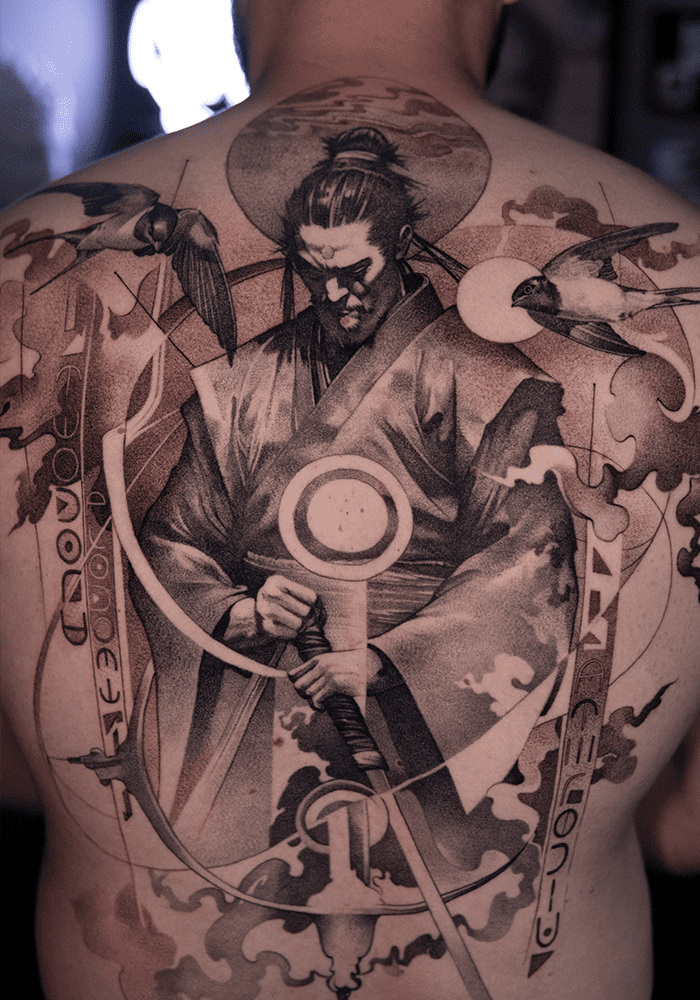
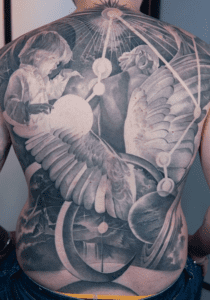
If you request a realistic composition or a complex black & grey project, the artist will study the area where the pigment will be applied. For example, an incorrectly placed portrait on the forearm will distort with every movement of the hand. We build the unique composition so that the main elements remain visible and unaltered by the body’s natural movement, using muscle lines to guide the flow of the graphic elements.
3. The Consultation Process: Turning an Idea into a Project
We do not accept walk-ins because a piece with real depth requires preparation time. We work exclusively by appointment, and the first step is always a preliminary discussion. Here is how our design stages unfold:
- Analysis Phase: We discuss your central idea, the elements you want to include, and equally important, what you do not like. We assess the condition of your skin and the size of the area.
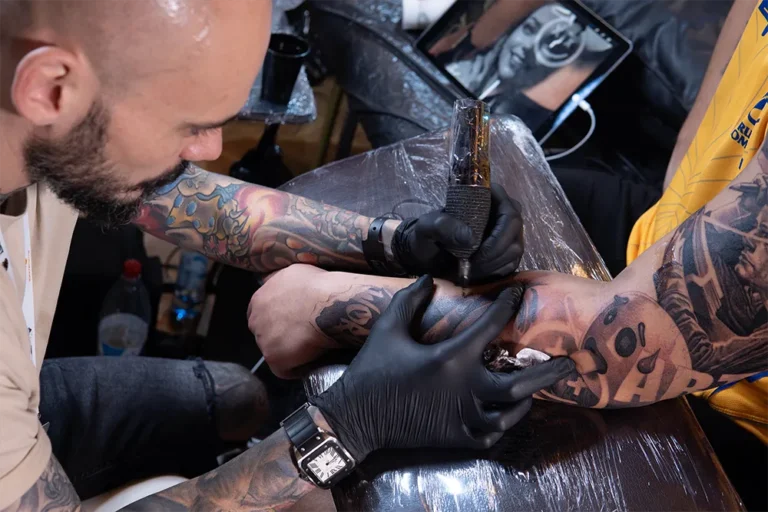
- Artistic Interpretation: The artist takes this information and passes it through the filter of their style (whether that is realism, illustrative, graphic, or the 3RL whipshading technique). TART Tattoo is not a mechanical execution studio; we bring our technical expertise to ensure the tattoo remains readable 10 or 20 years from now.
- Final Adjustments: The design is presented on the day of the session (or shortly before, depending on complexity). The exact size and final details are always decided together with you in the studio, using a stencil applied directly to the skin to verify the anatomical fit.
4. Approaching Special Technical Cases (Cover-ups and Reworks)
The refusal to work from a predefined template is even more critical in the case of complex cover-up projects or tattoos over scars. Here, a catalog is entirely useless. Effective coverage requires a custom design that uses organic shapes, deep shadows, and contrast to camouflage old pigment or the texture of scarred tissue.
Conclusion: A serious tattoo is an investment of time and resources from both sides. By choosing a custom design, you receive a piece with character, executed with rigor, that belongs exclusively to you.
Write to us to schedule a consultation and start working on your project.